
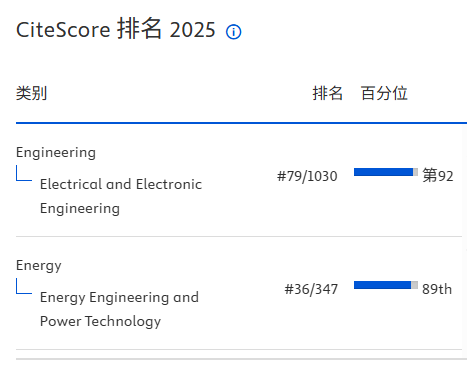
On June 3, 2026, Elsevier officially released the 2025 CiteScore metrics. iEnergy achieved a CiteScore 2025 of 11.9, representing a 61% increase over the previous year. The journal now ranks among the top 8% worldwide in the Electrical and Electronic Engineering category, placing 79th out of 1,030 journals.
iEnergy is sponsored by Tsinghua University, published by Tsinghua University Press, and edited by Professor He Jinliang of Tsinghua University. Within just three years of its inaugural issue in March 2022, the journal has been indexed in ESCI, EI, Scopus, DOAJ, CAS, and Inspec, and has also been selected for the High-Starting-Point New Journal Program under China’s Excellence Action Plan for Scientific and Technological Journals.
The Editorial Office would like to express its sincerest gratitude to all authors, reviewers, readers, Editorial Board members, Early-Career Editorial Board members, the sponsoring institution, academic supporting organizations, and the publisher for their longstanding attention to and support for the journal’s development. The journal will continue to uphold the highest standards of academic rigor, follow best practices in transparent publishing, continuously enhance its quality, and provide an even better platform for scholarly exchange.
We look forward to working together with you to achieve even greater success.
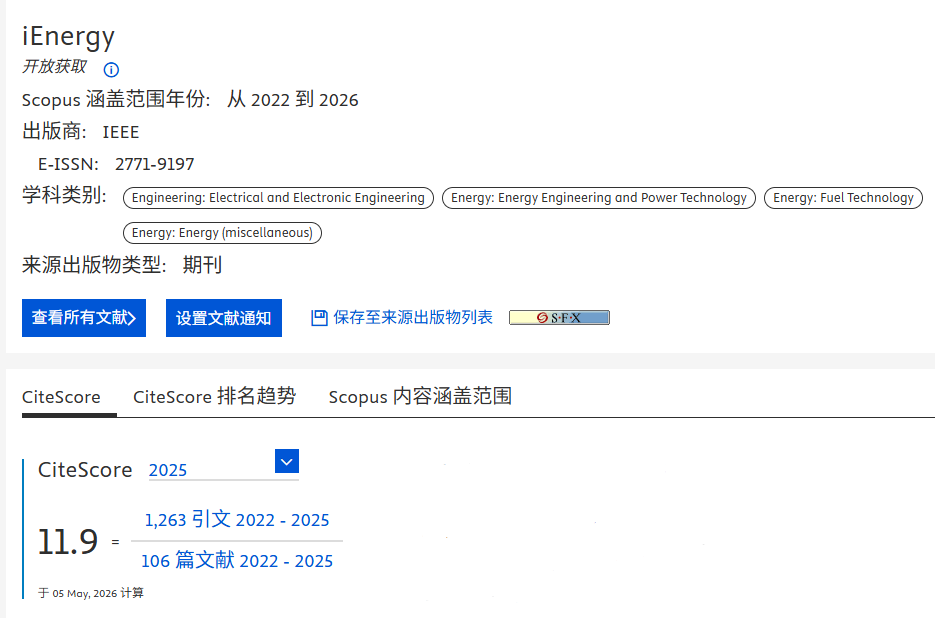
CiteScore Rankings
How CiteScore Is Calculated
CiteScore 2025 is calculated by dividing the total number of citations received during 2022–2025 by all articles, reviews, conference papers, book chapters, and data papers published during 2022–2025 by the total number of publications issued during the same period. As one of the internationally recognized metrics for evaluating academic journals, CiteScore™ provides impact assessment for more than 30,000 peer-reviewed journals, book series, conference proceedings, and trade publications worldwide, offering valuable decision-making references for researchers and enhancing the quality and efficiency of research evaluation.
Reprinted from the “TUP Climate Change and Energy & Environment Editorial Office” WeChat Official Account


 News & Events