On the morning of May 13, the launch event of “Dianyuan 1.0,” China’s first AI academic knowledge engine for the electrical engineering discipline, was held at the Department of Electrical Engineering, Tsinghua University. The event was jointly organized by the Department of Electrical Engineering of Tsinghua University and the Tsinghua Sichuan Energy Internet Research Institute. As the first AI-powered disciplinary knowledge engine and professional intelligent infrastructure specifically designed for electrical engineering in China, the release of “Dianyuan 1.0” provides a new foundation for intelligent development in the field and marks a new stage in the systematic evolution of disciplinary intelligence ecosystems.
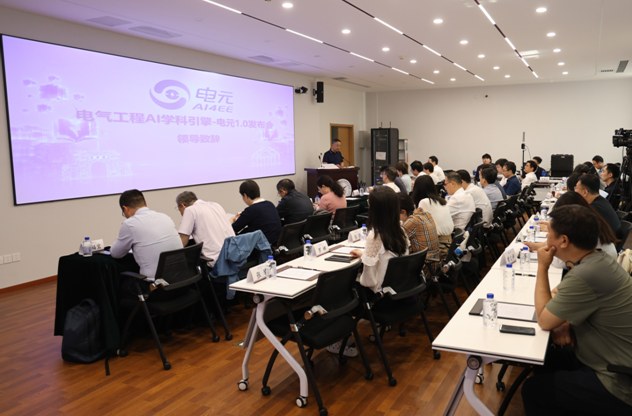
At the conference
The event received strong attention and support from partner universities, national research institutes, and leading industry organizations. Invited guests included Liu Nian, Vice Dean of the School of Electrical and Electronic Engineering at North China Electric Power University; Wang Jianqiang, Vice Dean of the School of Electrical Engineering at Beijing Jiaotong University; Jin Fubao, Vice Dean of the School of Energy and Electrical Engineering at Qinghai University, and member of the Teaching Committee Zhang Qiang; Zhu Zhixiang, Party Secretary of the Graduate School of China Electric Power Research Institute; Luo Na, Director of the Science and Construction Office of China Electric Power Research Institute; Qin Hongxia, Vice President and Chief Engineer of Beijing Sifang Automation Co., Ltd.; and Su Xinyi, Deputy Director of the Clean Energy Institute of China Electric Power Planning & Engineering Institute.
From Tsinghua University, attendees included Yu Xinjie, Director of Human Resources and Professor at the Department of Electrical Engineering; Wang Shuaiguo, Director of the Online Education Center and head of XuetangX; Zhu Guiping, Director of the Basic Mathematics Teaching Center and Professor at the Department of Electrical Engineering; Lei Huan, Deputy Director of the Academic Planning and Development Office; Yuan Fang, Deputy Director of the Information Technology Office; Zheng Zedong, Party Secretary of the Department of Electrical Engineering; Kang Chongqing, Dean of the Department of Electrical Engineering, Director of the Tsinghua Energy Internet Innovation Institute, and Director of the Tsinghua Sichuan Energy Internet Research Institute; Yu Zhanqing, Deputy Party Secretary of the Department; and Associate Chairs Lu Chao and Chen Laijun. Faculty and student representatives inside and outside Tsinghua also participated both online and offline. The event was hosted by Lu Chao.
Kang Chongqing delivered the opening address. He noted that electrical engineering, as a core discipline supporting national energy strategy, is currently at a critical window of opportunity for digital and intelligent transformation. At the beginning of 2025, the Department of Electrical Engineering formally proposed the AI4EE concept, which is rooted in traditional Electrical Engineering while redefining its two “E”s: the first E stands for Electricity/Energy, and the second E stands for Education. The development of the dedicated disciplinary knowledge engine “Dianyuan 1.0” is not only an implementation of Tsinghua University’s 15th Five-Year Plan strategy for AI-empowered educational transformation and disciplinary innovation, but also a proactive step by the department to embrace technological change and advance disciplinary intelligence development. The project fully leverages a “five-in-one” collaborative framework, with the Tsinghua Sichuan Energy Internet Research Institute deeply involved throughout, providing comprehensive support in platform development, resource integration, and application expansion. He expressed gratitude to partner universities, research institutes, and industry organizations for their strong support, and emphasized that the department will uphold an open and shared development philosophy to jointly build an intelligent ecosystem for electrical engineering.
Lei Huan stated in her remarks that Tsinghua University has always regarded disciplinary intelligence as a key driver of high-quality academic development. The release of “Dianyuan 1.0” represents an important outcome of the department’s response to the university’s strategic deployment and its exploration of a new AI + discipline integration model. She expressed hope that the department will use this initiative as an opportunity to establish a benchmark for cross-disciplinary collaboration and provide replicable and scalable experience for the university’s broader efforts in disciplinary intelligence development.
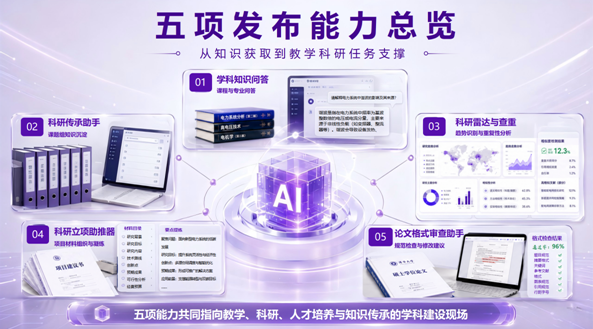
Overview of “Dianyuan 1.0” Capabilities
Professor Zhang Pengcheng, representing the project team, delivered a launch report on “Dianyuan 1.0,” systematically outlining its development background, design philosophy, and core capabilities. He stated that “Dianyuan 1.0” is built on the core principles of “trustworthy, controllable, and evolvable.” By integrating knowledge graphs, hybrid retrieval methods, and evidence traceability technologies, the system constructs a professional knowledge foundation, a trustworthy reasoning framework, and a domain-specific application ecosystem for electrical engineering. It also establishes a three-tier knowledge management mechanism consisting of public shared repositories, institutional private repositories, and cross-institution authorization, providing strong support for collaborative knowledge co-construction across multiple organizations. Project team member and postdoctoral researcher Yan Kang demonstrated the practical applications of “Dianyuan 1.0,” showcasing its core functions in teaching Q&A support for core courses, knowledge graph construction, cross-database literature retrieval, and frontier research tracking, effectively covering key needs in both teaching and research.
Looking ahead, Professor Liu Di introduced the development roadmap for “Dianyuan 2.0.” Dianyuan 2.0 will further deepen cross-institution collaboration mechanisms, expand teaching and research application scenarios, and enhance intelligent agent coordination and trustworthy output capabilities. The project team will continue to uphold the principles of “co-construction, sharing, and win-win cooperation,” working with partners to continuously iterate and improve the system, jointly promoting the deep integration of AI technology and electrical engineering, and evolving from a single-disciplinary knowledge engine into an industry-wide intelligent ecosystem.
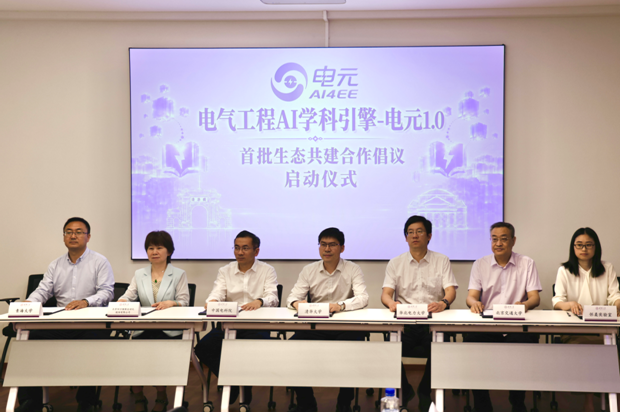
Launch Ceremony of the First Batch of Ecosystem Co-Building Partnerships
At the event, the Department of Electrical Engineering of Tsinghua University reached consensus on the first batch of ecosystem co-construction partnerships with North China Electric Power University, Beijing Jiaotong University, Qinghai University, Huairou Laboratory, China Electric Power Research Institute, Beijing Sifang Automation Co., Ltd., and other institutions and enterprises. Representatives from all parties jointly witnessed this important milestone. Partners will collaborate on application pilots, scenario co-development, resource construction, and feedback optimization around the “Dianyuan” platform, jointly building an open, shared, and co-evolving intelligent ecosystem for the electrical engineering discipline. During the event, Liu Nian from North China Electric Power University and Zhu Zhixiang from China Electric Power Research Institute, representing academia and industry respectively, delivered speeches sharing their perspectives on disciplinary intelligence development and cross-institution collaboration, helping build consensus. The Department of Electrical Engineering of Tsinghua University also issued an open invitation for ecosystem co-construction, welcoming more partners to join the Dianyuan ecosystem and jointly advance innovation and application of AI technologies in electrical engineering.
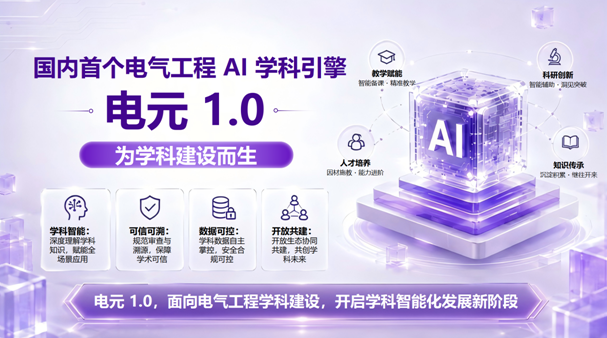
“Dianyuan 1.0” Advances Intelligent Development of Electrical Engineering Discipline
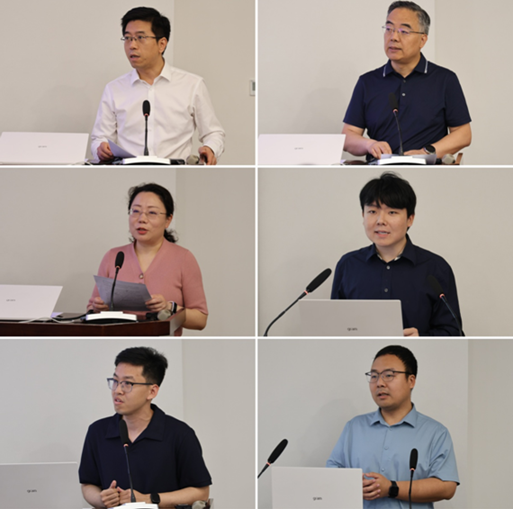
Speeches and Discussions
Attendees engaged in discussions on topics including AI + electrical engineering disciplinary development and ecosystem co-construction. Participants noted that the release of China’s first AI academic knowledge engine for electrical engineering, “Dianyuan 1.0,” provides a new practical foundation and core support for disciplinary intelligence development, and expressed expectations for continued collaboration to jointly contribute to scientific and technological advancement in China’s electrical engineering field.
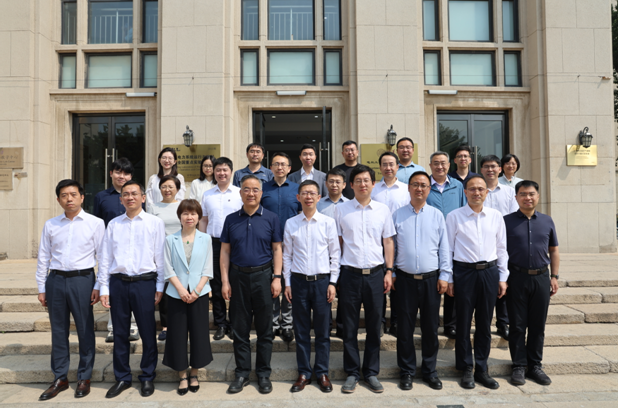
Group Photo of Participants


 News & Events