On January 21, a joint delegation including Kisik Kim, President of the National Assembly Futures Institute of Korea; 22nd National Assembly members JeeHye Park and Jaejun Woo; and professors Sung Jae Kim, Jeyong Yoon, Suk Won Cha, Jung Ik Ha, and Jungwon Park from Seoul National University visited the Department of Electrical Engineering and Applied Electronics (EEA) at Tsinghua University to exchange views on the development of the electrical engineering discipline. Participants in the discussion included Zheng Zedong, Party Secretary of the department; Yu Zhanqing, Deputy Party Secretary; Gao Feng, Deputy Director of the Tsinghua Energy Internet Innovation Institute (Beijing); Li Shisong, Assistant Dean of EEA; and Wang Chao, Assistant Researcher at the State Key Laboratory of New-Type Power System Operation and Control. The meeting was chaired by Zheng Zedong.
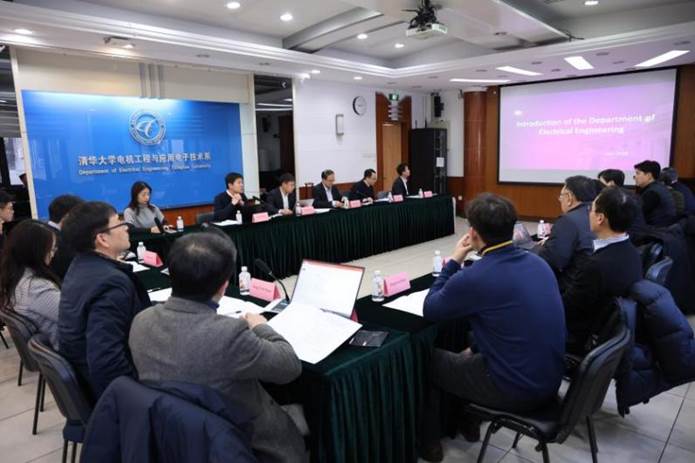
Zheng Zedong extended a warm welcome to the delegation and reviewed the department’s development history and academic foundations, introducing its current development framework and core research missions across disciplines.
Kisik Kim, on behalf of the Korean delegation, stated that a zero-carbon society is a shared vision for humanity. China has achieved remarkable progress in carbon reduction and renewable energy development, and the Department of Electrical Engineering at Tsinghua has strong international influence in related research fields. He expressed hope that this visit would provide valuable experience for Seoul National University and lay a foundation for deeper future cooperation.
During the meeting, both sides conducted comprehensive discussions on discipline development and research progress. Li Shisong introduced the department’s development path and achievements in discipline layout, team building, and research breakthroughs, highlighting the core ideas of interdisciplinary integration and innovation-driven development. Gao Feng presented the basic overview, vision, and achievements of the Tsinghua Energy Internet Innovation Institute, especially in scientific innovation, technology transfer, and international cooperation, offering diverse ideas for expanding industry-academia-research collaboration. Wang Chao introduced the background, mission, development goals, operational mechanisms, and current status of the State Key Laboratory of New-Type Power System Operation and Control.
Sung Jae Kim introduced the Seoul National University Energy Initiative, outlining its positioning, key research directions, and implementation pathways. As a core research platform in Korea’s energy sector, it has achieved significant results in carbon capture, utilization and storage, liquid hydrogen storage, and renewable energy development. Jeyong Yoon provided an overview of Korea’s renewable energy development plans and power system status in the context of national energy strategy, sharing practical experience in energy security, low-carbon technology innovation, and industrial collaboration.
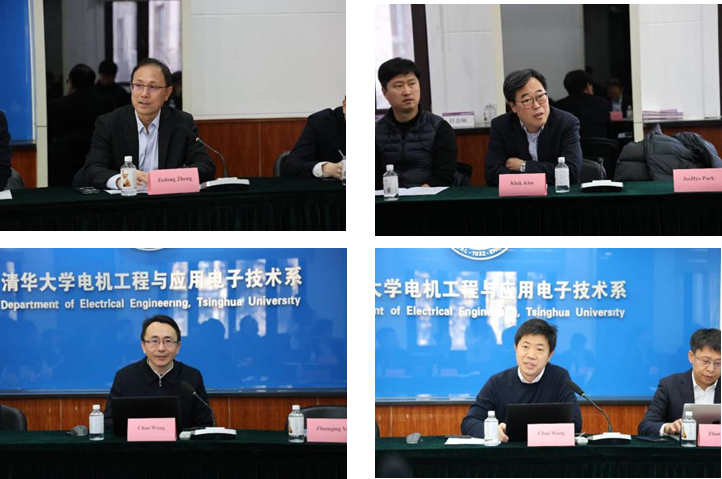
During the discussion session, both sides engaged in in-depth exchanges on key topics such as technology transfer pathways and industry-academia-research collaboration. Kisik Kim noted that the department’s technological achievements and innovative ideas were highly impressive, and that the exchange had built an important bridge for future cooperation.
Zheng Zedong and Sung Jae Kim concluded the meeting. Zheng emphasized the importance of building a close cooperation mechanism through academic exchanges to jointly tackle key challenges in energy transition. Sung stated that he would actively promote continued exchanges and explore practical cooperation forms such as joint research and talent exchange.
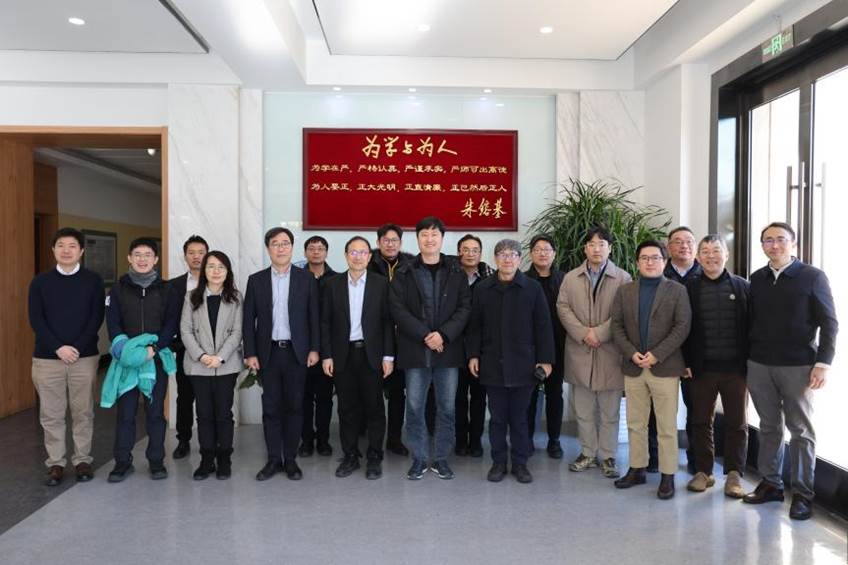
Group Photo After the Meeting


 News & Events