Recently, the Energy Intelligence Laboratory (EILAB) led by Professor Kang Chongqing and Associate Researcher Guo Hongye from the Department of Electrical Engineering, Tsinghua University, has made research progress in the field of interaction between energy-intensive industrial users and the power grid. The team proposes that, in a carbon-neutral power system, energy-intensive industries can utilize their moderate excess production capacity and product storage capability to provide cross-seasonal flexibility for the power system, thereby forming a new paradigm of grid–load interaction for power systems with high shares of renewable energy. The relevant research findings, entitled “Industrial Overcapacity Can Enable Seasonal Flexibility in Electricity Use,” have been published in the international academic journal Nature Energy.
New Opportunities: Variability of Renewable Energy and Industrial Overcapacity
Driven by the “dual-carbon” goals, the share of renewable energy sources such as wind and solar power in the electricity system continues to increase. Renewable generation exhibits significant seasonal and stochastic variability, meaning that future power systems will require coordinated interaction among source, grid, load, and storage across multiple time scales to ensure long-term safe and stable operation. For a long time, industrial loads have been regarded as high-quality demand-side flexibility resources due to their large scale and advanced management capabilities. However, under traditional demand response models, the actual participation space for energy-intensive industrial users remains limited. On the one hand, many energy-intensive production processes require stable and continuous operation. Frequent hourly or intra-daily load adjustments may lead to reduced production efficiency, equipment thermal fatigue, and increased process risks. On the other hand, enterprises typically prefer to fully utilize existing production capacity to reduce unit fixed costs and improve operational returns. Nevertheless, traditional energy-intensive industries such as steel, cement, and electrolytic aluminum have long faced a certain degree of structural overcapacity during industrial transformation and upgrading. In the past, overcapacity was often regarded as a problem in industrial operation. However, in power systems with high penetration of renewable energy, moderate excess capacity may instead become a new type of flexible regulatory resource. This shift creates new opportunities for industrial users to participate in grid–load interaction, meaning that energy-intensive industries can achieve deep coordination with the power system by adjusting operating rates without deviating from their production objectives.
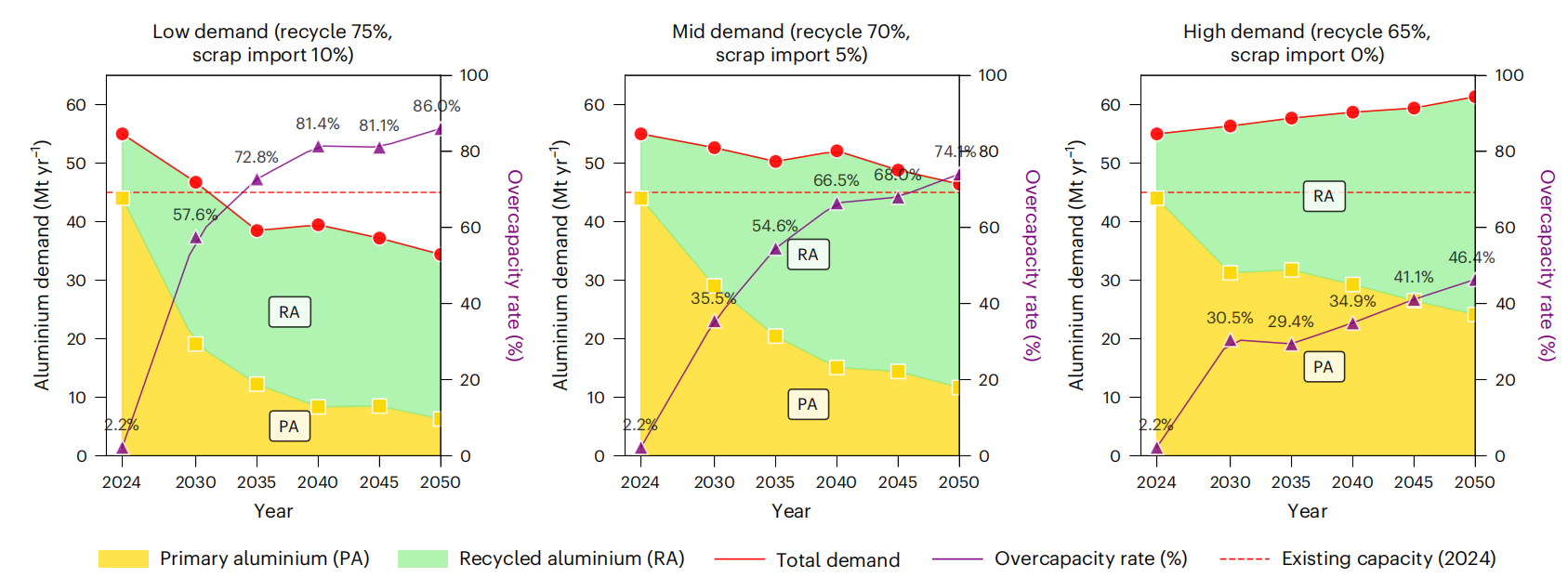
Figure 1: China’s electrolytic aluminum demand forecast: the gap between the red dashed line (existing capacity) and the yellow area (future demand) represents excess capacity in aluminum smelters
Overcapacity Enables New Opportunities for Flexible Electricity Use by Large Industrial Users
The research team takes the electrolytic aluminum industry as a representative case and develops a refined model of energy-intensive industrial production lines. By coupling electricity market mechanisms with power system operations, the team employs a self-developed integrated optimization framework based on an iterative decomposition algorithm for efficient solution. Calculations are conducted using planning data for future power systems and energy-intensive industrial users in China. Results show that in future power systems with extremely high shares of renewable energy penetration, energy-intensive industrial users can participate in grid–load interaction through “long-cycle, seasonal operation.” Specifically, in the future, energy-intensive industries can utilize their widespread excess capacity to operate at full load and accumulate products during seasons with abundant wind and solar generation and low electricity prices, while strategically entering a “hibernation mode” and shutting down production during winter periods when electricity supply is tight and prices are high (Figure 2). Through multi-time-scale coordinated interaction between electrolytic aluminum users and the power system, production constraints of energy-intensive industries can be satisfied, while enabling better long-term supply–demand balance in new power systems.
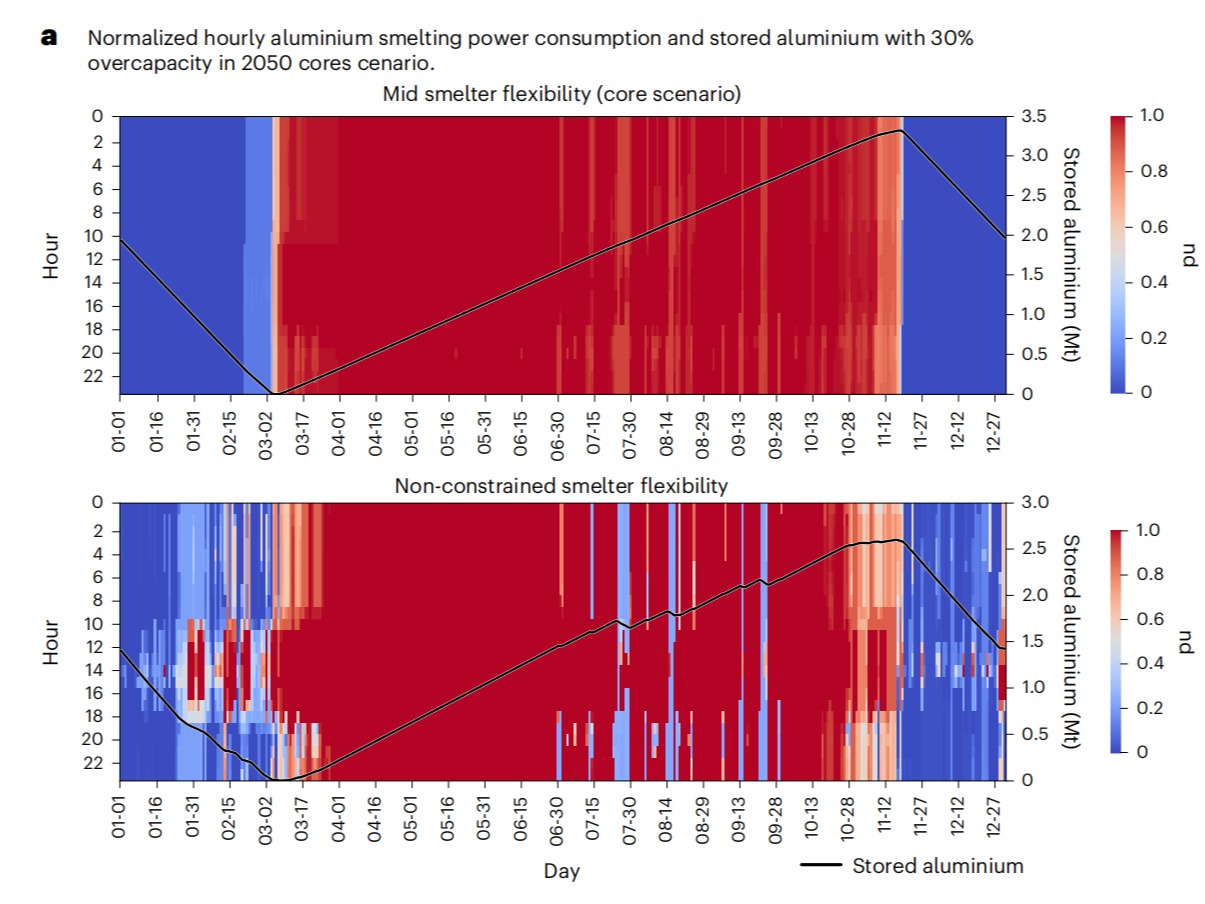
Figure 2: Optimal operating patterns of electrolytic aluminum users in a 2050 scenario: considering different levels of electrolyzer flexibility
System-Level Economic and Social Benefits of High-Energy Grid–Load Interaction
Estimates show that under China’s carbon-neutral 2050 low-carbon power system scenario, maintaining moderate excess capacity in electrolytic aluminum could generate significant system-level benefits. On the grid side, by reducing load during winter peak supply shortage periods, seasonal operation of the electrolytic aluminum industry could save 23–32 billion RMB annually in investment and operational costs for the power system, equivalent to 11%–15% of the total output value of the electrolytic aluminum industry. On the enterprise side, although seasonal operation leads to costs such as idle capacity depreciation, electrolyzer restart costs, storage costs, and capital costs, enterprises benefit from increased consumption of low-cost green electricity. Overall, the total production cost per ton of aluminum can still be reduced by more than 1,500 RMB, equivalent to about 10% of current production costs (Figure 3).
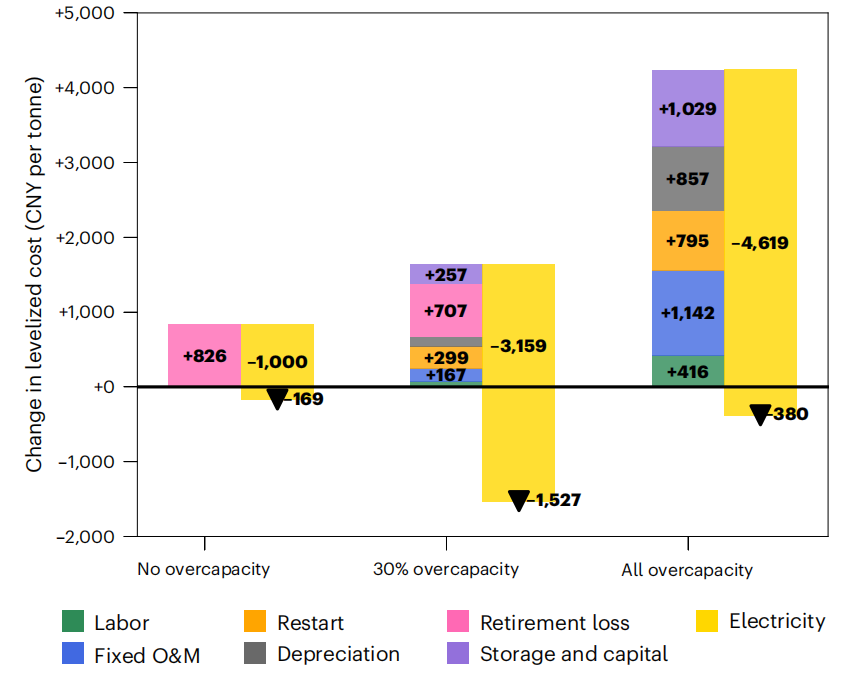
Figure 3: Levelized cost of electrolytic aluminum under different levels of excess capacity in a carbon-neutral scenario
At the societal level, this paradigm may also provide new insights for cross-sector labor allocation. Thermal power plants typically operate at higher load during winter, while aluminum smelters can strategically reduce or suspend production during the same period. The seasonal labor demand patterns of the two industries are partially complementary. Theoretically, this could reduce overall employment volatility across both sectors by 25%, mitigating some social impacts during the energy transition.
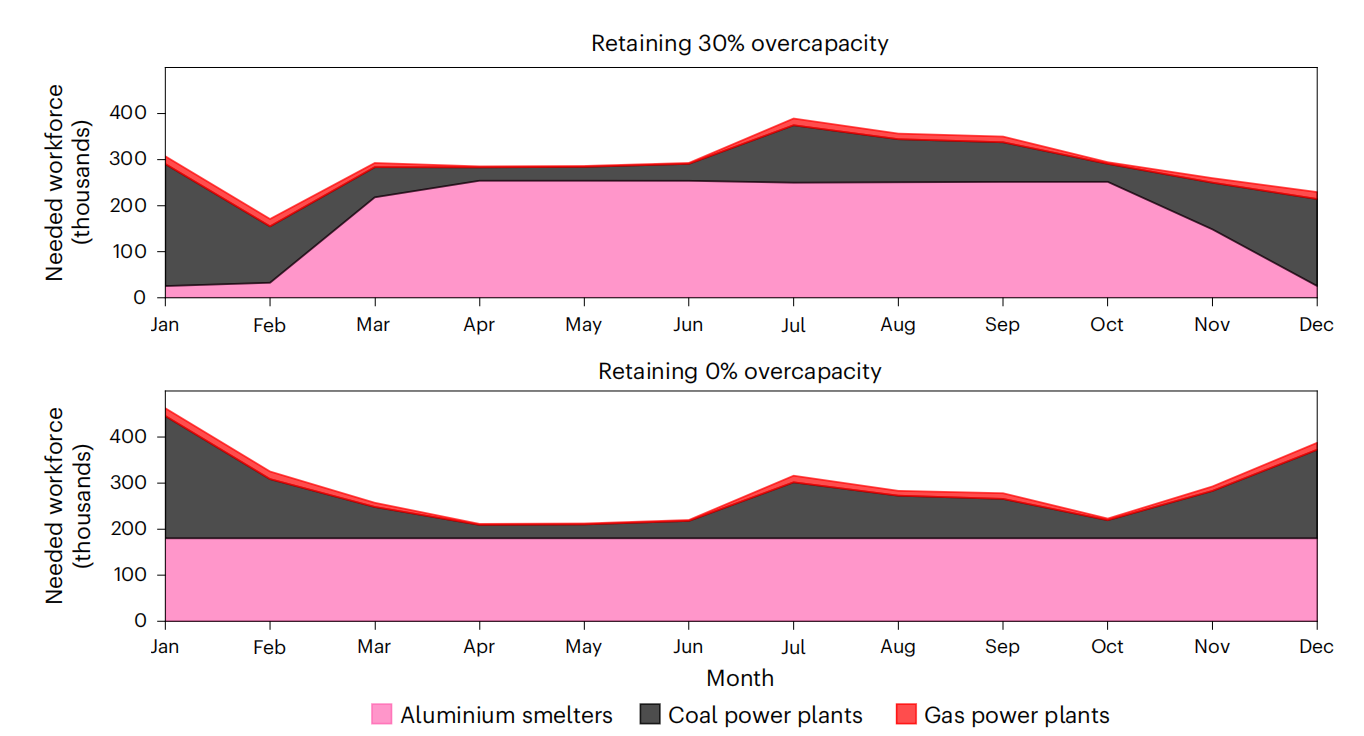
Figure 4: Projected monthly labor demand for aluminum smelters and coal/gas-fired power plants in 2050: with and without considering aluminum overcapacity
Conclusion and Outlook
From the long-term perspective of new power system development, one key to supporting high renewable energy integration lies in breaking the traditionally segmented operation mode between electricity generation and consumption. In the future, industrial production will no longer be a passive electricity consumer; instead, through appropriate electricity market mechanisms and optimized production organization, it can actively participate in power system regulation. This study reveals a new possibility: as low-cost but highly volatile wind and solar power gradually become the dominant energy source, moderate excess capacity in certain energy-intensive industries can serve as a “reservoir” for seasonal flexibility in the power system (Figure 5). It can both help the power system address seasonal supply–demand mismatches and provide enterprises with new pathways to reduce energy costs and enhance green competitiveness. Starting from the electrolytic aluminum industry, this idea also offers insights for other energy-intensive sectors such as steel and cement to participate in power system transformation. In the future, with further improvements in electricity market mechanisms and continued advancement in industrial digitalization, energy-intensive industrial users are expected to transform from traditional high energy-consuming and high-emission entities into important flexibility resources in new power systems.
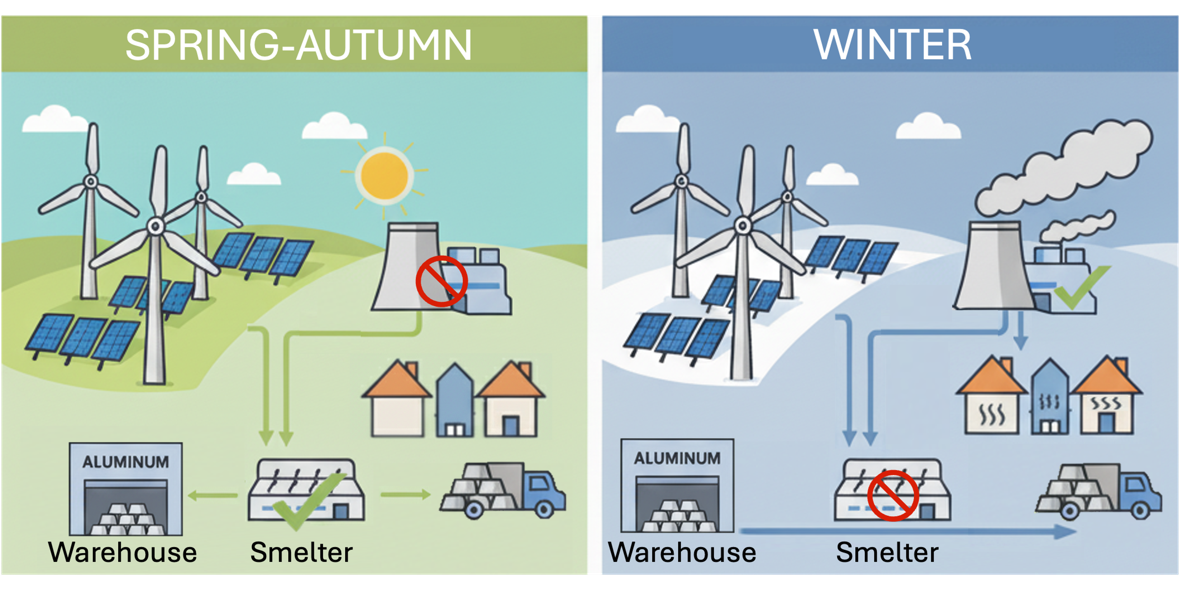
Figure 5: Seasonal operation paradigm of energy-intensive industries
Paper Information
PhD student of the Department of Electrical Engineering (Class of 2021), Lu Ruike, is the first author of the paper. Professor Kang Chongqing and Associate Researcher Guo Hongye are the corresponding authors. Co-authors include Associate Professor Jesse D. Jenkins (Princeton University), PhD candidate Anna Li (Princeton University), Dr. Hongxi Luo (Postdoctoral Researcher, Princeton University), Associate Researcher Wang Jianxiao (Peking University), Associate Researcher Du Ershun (Low-Carbon Energy Laboratory, Tsinghua University), and PhD student Yan Shen (Class of 2025, Department of Electrical Engineering, Tsinghua University), among others. This work was supported by the National Natural Science Foundation of China and the Tsinghua University Carbon Neutrality and Energy Internet Big Science Program.
Original link: https://www.nature.com/articles/s41560-026-02073-y
Brief Introduction of Lead Authors
Lu Ruike (First Author): PhD student (Class of 2021), Department of Electrical Engineering, Tsinghua University. From March 2025 to February 2026, he was jointly trained at Princeton University, USA. His research focuses on modeling and optimization methods for market-based grid–load interaction involving massive industrial users, including computationally efficient energy consumption mechanism modeling, parameter identification adapted to low-frequency measurements, and data-driven aggregation of dispatchable feasible regions. He received the IEEE PES PhD Dissertation Contest Best Presentation Award (two recipients worldwide each year).
E-mail: lrk21@mails.tsinghua.edu.cn
Personal website: https://rick10119.github.io/
Guo Hongye (Corresponding Author): Associate Researcher at the Department of Electrical Engineering, Deputy Director of the Power Systems Research Institute. Main research areas include electricity markets, demand-side flexibility, and applications of artificial intelligence in power systems. He serves as an expert in the UK–China Electricity Market Reform Advisory Group, a member of the Youth Working Committee of the China Energy Research Society, and Co-Chair of the IEEE PES Task Force on Modeling and System Design of Electricity Market Mechanisms. He is also an Associate Editor of IEEE Transactions on Smart Grid and iEnergy.
E-mail: hyguo@tsinghua.edu.cn
Kang Chongqing (Corresponding Author): Professor and Dean, Department of Electrical Engineering, Tsinghua University; IEEE Fellow; IET Fellow; Fellow of the China Electrotechnical Society; Fellow of the Chinese Society for Electrical Engineering. His research focuses on power system planning and optimal operation, renewable energy, and low-carbon power technologies. He has authored seven monographs in Chinese and English, published more than 600 papers, and received over 42,000 citations. He is listed as a Highly Cited Researcher by Clarivate and a Highly Cited Scholar by Elsevier. He serves as Chair of IEEE PES PCCC, member of the IEEE PES Long-Term Strategy Committee, and member of CIGRE SC C1 Strategic Committee.
E-mail: cqkang@tsinghua.edu.cn
Team Introduction
The Energy Intelligence Laboratory (EILAB), Department of Electrical Engineering, Tsinghua University, focuses on major opportunities in the transformation of the energy and power sector. Its research areas include “electricity markets and energy think tank studies,” “energy system dispatch, operation, and trading decision-making,” and “low-carbon power planning, operational simulation, and carbon accounting.” The team has received more than 10 provincial and ministerial-level science and technology awards and over 20 industry awards including the China Electric Power Science and Technology Award, as well as 1 China Patent Award. In the past five years, the team has published more than 300 papers, including over 180 SCI-indexed papers. Fifteen papers have been recognized as ESI hot papers or highly cited papers. The team has also been granted more than 40 invention patents. The team has deeply participated in China’s electricity sector reform process and has provided important advisory and decision-support services to the National Development and Reform Commission, the National Energy Administration, the State Council Research Office, and the State-owned Assets Supervision and Administration Commission of the State Council.


 News & Events