At 9:00 AM on December 28, 2025, in the main control room of the He’nan Lingbao DC Converter Station, following the final command issued by the National Electric Power Dispatching and Control Center, China's completely independently developed, world's first new-generation DC transmission converter valve based on IGCT devices—the Hybrid Commutation Converter Valve (hereinafter referred to as the "HCC Valve")—was officially put into commercial operation after successfully completing a 168-hour trial run. This marks the resolution of the "commutation failure" problem that has plagued the global DC transmission field for over half a century.
The world's first (set) HCC Valve trial run was successfully completed.
The converter valve is the core equipment in DC transmission projects that achieves the conversion between alternating current and direct current, analogous to the "heart" of a DC transmission project. Currently, DC transmission projects worldwide commonly use thyristor-based converter valves. Limited by the "semi-controlled" characteristic of thyristors, which can only be turned on but not actively turned off, there is a risk of "commutation failure" during AC/DC conversion. This can cause an "abrupt halt" in the power transmission process, seriously threatening the safe and stable operation of large power grids.
Facing this challenge, a team led by Professor Zeng Rong from Tsinghua University, relying on Huairou Laboratory and the State Key Laboratory of Power Systems at Tsinghua, delved deep into source innovation. Starting from first principles, they pioneered a new hybrid commutation conversion technology based on reverse-blocking IGCT devices. Collaborating with Xi'an Particle-wave, CRRC Times Semiconductor, and after thousands of process experiments and seven rounds of full-process iterative tape-outs, they developed the world's first 8kV/3kA reverse-blocking Integrated Gate Commutated Thyristor (IGCT) device. They then formed an "industry-university-research-application" joint R&D team with the State Grid Equipment Department, State Grid Henan Electric Power, State Grid DC Center, State Grid Economic and Technological Research Institute, China Electric Equipment Group's XD System Company, and XJ Electric Co., Ltd. After nine years of continuous research and development, they produced the world's first IGCT-HCC converter valve, achieving an original technological breakthrough across the entire "principle-device-equipment-system" chain.
I. Creating the "Strongest Core" for DC Transmission
The research team's independently developed reverse-blocking IGCT device withstands a bidirectional voltage of 8kV, carries a current of 3kA, and can interrupt a current of 6.6kA. It can control both turn-on and turn-off. It is the first reverse-blocking IGCT device for DC transmission applications, fundamentally overcoming the shortcomings of traditional thyristors.

Figure 1: 8kV/3kA Reverse-Blocking IGCT Device
II. Developing a "Milestone" Equipment for DC Transmission
The HCC Valve leverages the characteristics of the IGCT device to construct a hybrid commutation mechanism combining "natural commutation" and "forced commutation". During normal system operation, the HCC converter utilizes the ultra-short reverse recovery time of the IGCT device to achieve "enhanced recovery natural commutation", reducing reactive power demand by 20% under steady-state conditions. When disturbances or faults occur in the power grid, it performs "active turn-off forced commutation" via the IGCT device to eliminate the risk of commutation failure. Thus, the HCC Valve provides a dual safeguard for DC transmission projects under both "normal" and "disturbed" states.
The research team overcame the challenge of series voltage equalization during the active turn-off of hundreds of devices. They established a transient and steady-state voltage protection framework for the hybrid commutation converter at the "device-equipment-system" three levels. They developed a new type of valve base electronics system and a highly reliable valve control system suitable for all operating conditions of the hybrid commutation converter, successfully developing the world's first HCC Valve. Hailed as a "milestone" equipment for DC transmission, it has also been selected as a first (set) major technical equipment by both the Ministry of Industry and Information Technology and the National Energy Administration.
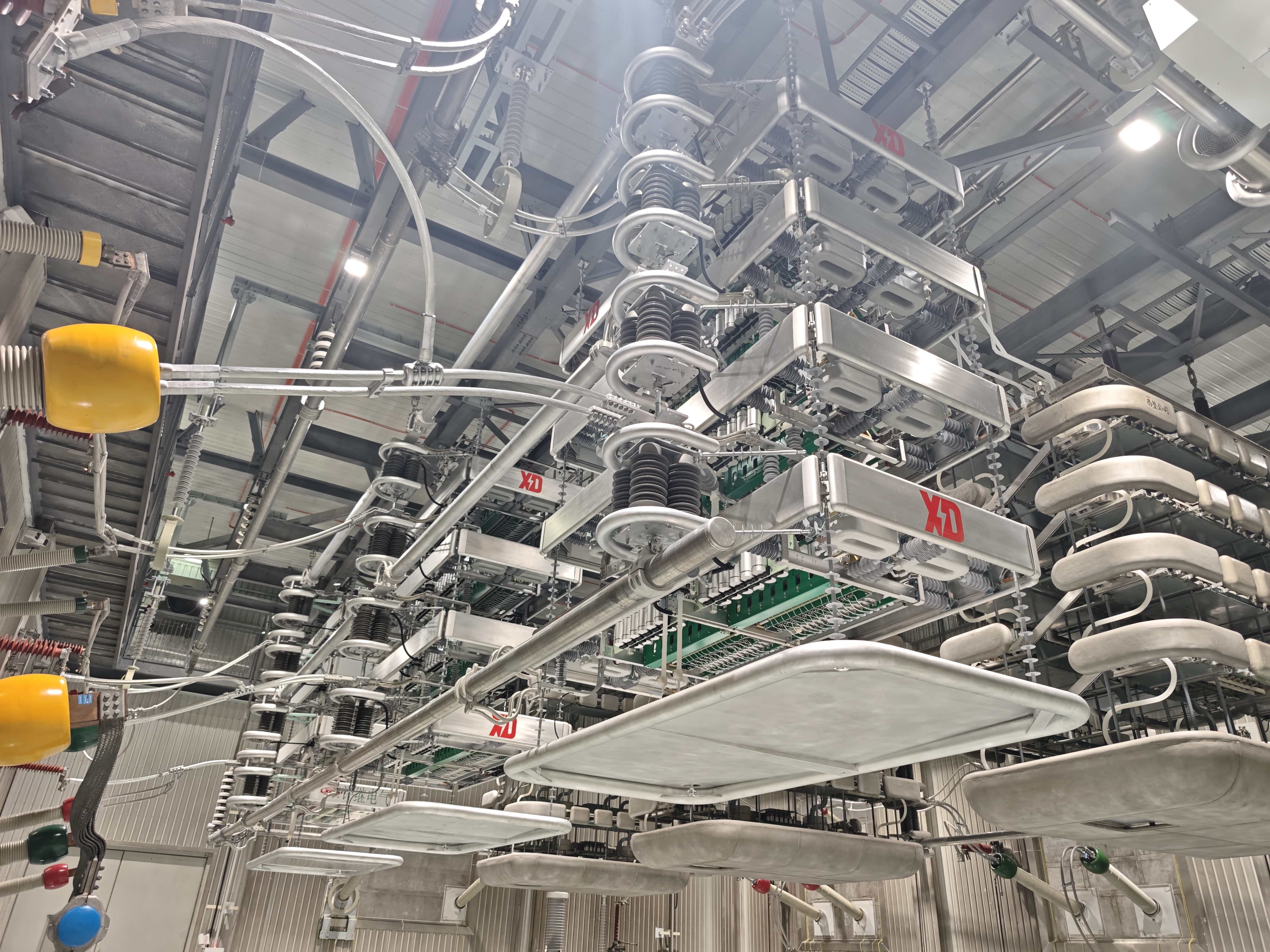
Figure 2: The World's First HCC Valve
III. Completing a "Heart Transplant" Modification, Completely Eliminating the Risk of "Cardiac Arrest"
The Henan power grid is a crucial hub for West-to-East power transmission and North-South interconnected supply. The Lingbao Project is China's first fully domestically produced back-to-back DC transmission project and an important node interconnecting the Central China and Northwest power grids. However, it has frequently experienced commutation failure risks, threatening grid security.
Addressing this issue, the State Grid Corporation of China applied the HCC Valve for the first time worldwide. This is equivalent to performing a "heart transplant" modification on the traditional thyristor converter valve, replacing it with a "super heart" equipped with its own "pacemaker" function. This modification supports the converter valve in maintaining a continuous and stable commutation "heartbeat" even during grid faults, fundamentally solving the commutation failure problem and eliminating the safety risk of cascading grid blackouts under extreme circumstances.
The successful development and commercial operation of the HCC Valve represent a major landmark achievement signifying China's international leadership in DC transmission. It will support the comprehensive renovation of China's first batch of DC transmission projects and also provides a brand-new solution for the West-to-East power transmission strategy as it transitions from transmitting stable hydro/thermal power to transmitting variable wind and solar power.


 News & Events