Recently, the Beijing Municipal Science & Technology Commission and the Administrative Committee of Zhongguancun Science Park officially announced the list of recognized Beijing Key Laboratories for 2025. The "Beijing Key Laboratory of Non-Supplementary Combustion Compressed Air Energy Storage," led by the Department of Electrical Engineering and Applied Electronics (EEA) at Tsinghua University and co-established by the State Grid Electric Power Engineering Research Institute Co., Ltd., has been successfully approved. Professor Mei Shengwei from Tsinghua University's EEA will serve as the Director of the laboratory.
Focusing on Energy Storage Technology Innovation
The laboratory will address challenges in non-supplementary combustion compressed air energy storage (CAES), such as optimal design under multiple operating conditions, coordinated control under multiple modes, and flexible operation across various scenarios. It will conduct research on technologies for efficient, safe, and stable operation of energy storage systems, promote preliminary validation for non-supplementary combustion CAES demonstration projects, facilitate the implementation of demonstration applications and industrial promotion, and lead the international development of non-supplementary combustion CAES technology.
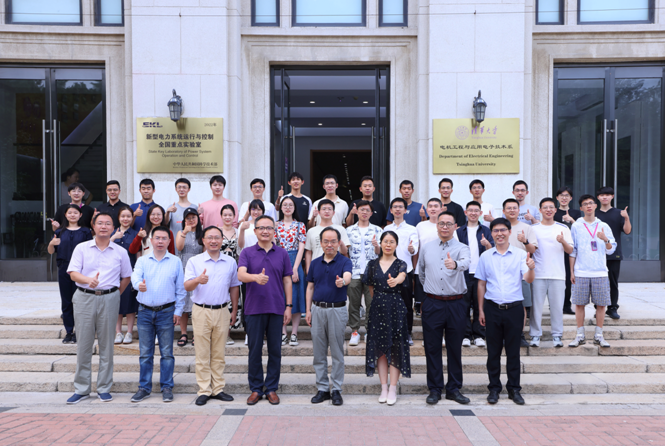
Team Photo
Brief about the Laboratory Director

Mei Shengwei
Professor at Tsinghua University, Dean of the College of Energy and Electrical Engineering at Qinghai University, National Science Fund for Distinguished Young Scholars Recipient, Changjiang Scholar.
Professor Mei has long engaged in research on power system control, as well as the safe transmission, efficient consumption, and clean storage of large-scale new energy. He is an IEEE Fellow, and a Fellow of the Chinese Association of Automation (CAA), the Chinese Society for Electrical Engineering (CSEE), and the China Electrotechnical Society (CES). He serves as the academic leader for the NSFC Innovative Research Group project "Dispatch and Control of Large-Scale Wind and Solar Power" and the Chief Scientist for the national energy storage demonstration project "Jintan 60MW/300MWh Salt Cavern Compressed Air Energy Storage" in Jiangsu. He is also the lead for the National Key R&D Program project "Large-Scale Geological Hydrogen Storage." He has authored 10 books and published 642 papers, including 285 SCI-indexed papers, with over 30,000 citations and an H-index of 76. He holds 205 authorized invention patents and has contributed to the release and approval of 24 standards. His accolades include a second prize for National Scientific and Technological Progress (ranking 1st), a second prize for National Natural Science (ranking 2nd), 13 first prizes for provincial/ministerial scientific and technological progress (9 as the first completer), the Ho Leung Ho Lee Foundation Science and Technology Innovation Prize, and the inaugural Gao Jingde Scientific and Technological Achievement Prize.
Deeply Engaged in Engineering Application and Transformation
Professor Mei Shengwei's team has undertaken major special projects, including the National Development and Reform Commission's "Unveiling and Leading" project, and projects from the Qinghai Provincial Department of Science and Technology and the Inner Mongolia Department of Science and Technology. They have successfully constructed China's first commercially operated non-supplementary combustion salt cavern CAES power station (Jintan, Jiangsu, 60MW) and the world's first wide-sliding pressure CAES power station in a cold region (Huade, Inner Mongolia, 60MW). Collaborating with central enterprises such as the China National Salt Industry Group, China Huaneng Group, and China Three Gorges Corporation, the team has supported the construction of 9 non-supplementary combustion CAES power stations. They are also supporting the construction of 12 stations in Qinghai, Jiangsu, Inner Mongolia, etc., which are expected to add 5200MW/25700MWh of regulation capacity. They have established a Flexible Compressed Air Energy Storage Joint Research Center with Anhui Yosun Technology Co., Ltd. The core technologies have 242 authorized invention patents. They have published over 710 SCI/EI papers and contributed to the release and approval of 24 standards (including China's first national standard for compressed air energy storage), pioneering the field of non-supplementary combustion CAES. Their honors include the Special Prize from the China Electrotechnical Society (the first in the society's 42-year history), the First Prize for Scientific and Technological Progress from Anhui Province, the First Prize for Electric Power Scientific and Technological Progress, and the CEC Electric Power Innovation Award.

Jintan 60MW/300MWh Salt Cavern Compressed Air Energy Storage Power Station, Jiangsu

Huade 60MW/240MWh Artificial Cavern Compressed Air Energy Storage Power Station, Inner Mongolia
Looking Ahead to the Future Development of Energy Storage
This approval will further promote Tsinghua University's leading role in the field of non-supplementary combustion compressed air energy storage.
In the future, through "industry-university-research" collaborative innovation, the laboratory will provide strong support for the sustainable development of China's non-supplementary combustion CAES and the broader energy industry. It will help China achieve a dual leadership position in both technological breakthroughs and engineering applications in the global non-supplementary combustion CAES sector, seizing the high ground in industry development.


 News & Events