On December 30, the Ministry of Education announced the 2025 Excellent Scientific Research Achievements Awards (Natural Science and Engineering Technology). Professor Kang Chongqing of Tsinghua University’s Department of Electrical Engineering led the project “Theory and Methods for Analysis and Optimization of Low-Carbon Power Systems,” which won the First Prize in Natural Science (contributors: Kang Chongqing, Zhang Ning, Wang Jianxiao, Du Ershun, Zhong Haiwang, Guo Hongye, Wang Peng, Xia Qing).
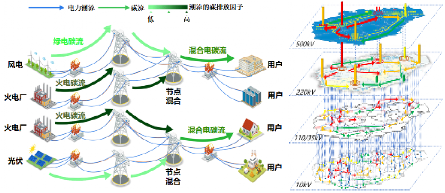
Power System Carbon Flow Theory – Spatiotemporal Coupling Mechanism between Grid Flow and Power Carbon Emissions
This project addresses the country’s major needs for low-carbon power transition, discovering and utilizing the coupling mechanism between power carbon emissions and the physical operation of the grid to guide clean, low-carbon, safe, and efficient coordination of generation, grid, load, and storage. Since 2009, the project team has pioneered theoretical research on low-carbon power technologies. Over 16 years, they solved three major challenges: analyzable carbon flow distribution in power systems, optimizable low-carbon dispatch, and coordinated carbon-electric planning. They established the power system carbon flow analysis theory, discovered the spatiotemporal coupling law between grid flow and power carbon emissions; proposed methods for low-carbon optimal power dispatch, clarifying the carbon reduction mechanism of coordinated generation-grid-load-storage operation; proposed methods for low-carbon optimal power planning, revealing the interactive effects of carbon trajectories and power system evolution. The team published China’s first monograph on low-carbon power. For contributions to low-carbon power, they received the IEEE PES Distinguished Power Engineering Education Award and led the preparation and release of CIGRE C1.39 technical guidelines for power planning. The project’s results have been widely applied in Beijing, Guangdong, Qinghai, and other regions for power carbon monitoring and emission reduction optimization, supporting national and regional carbon peak and carbon neutrality planning.


 News & Events